
A song about refusing to settle, working on yourself, and building a life that does not exist yet.
The Sculptor speaks directly to someone who wakes up tired every Monday to go to work, looks at their routine, and wonders if this is really all life has to offer.
The week repeats itself. The weekend arrives, and it gets used to go out, clear your head, or numb it a little because you are so sick of doing the same thing. Then Monday comes back around and the whole loop starts again.
The song begins by pointing at that person, but it does not stay there to judge them. At some point, something changes. They lock themselves away, clear their head, sit with the silence, and start working on themselves, even though they still do not know exactly how to get out.
When routine starts to feel like a sentence
The 9 to 5 in The Sculptor is about living on autopilot. It is not only about having an office job. It is about starting to believe that adulthood is just like this, that life simply works this way, and that there is no point expecting anything else.
Weekday, weekend, weekday again.
You get used to putting off the things you actually want to do because there is always something more important. Work, responsibilities, exhaustion, or whatever excuse is available slowly take up all the space. It is easy to settle into that strange kind of comfort where you are not happy either, but at least you know the routine.
That is where the beta paradox comes in. You know you want to change, but you keep waiting for the perfect moment to begin. Meanwhile, life keeps moving.
That is why the first verse asks:
"Are you sure this is all life has to offer?"
It is not a rhetorical question added to sound profound. It is the doubt that shows up when you realize you do not want to spend the next few years repeating the same thing.
The material and the sculptor
The song came from a quote by Alexis Carrel, a French surgeon and Nobel Prize winner:
"Man cannot remake himself without suffering, for he is both the marble and the sculptor."
That idea stayed with us because it says exactly what we wanted to talk about. Anyone trying to change has to be both the material being transformed and the person doing all the work.
There is no finished version of you waiting somewhere. You have to build skills, learn, work on yourself, and move toward something that has not been built yet.
That is what The Sculptor is about. No one is coming to rescue you. You take what you have, accept that there is still a lot of work ahead, and start shaping it.
Pain as fuel
The chorus connects directly to that idea:
"You gotta feel the pain to make the change"
To us, discomfort and suffering are part of the process when someone decides to genuinely change. That does not mean pain is something to chase for its own sake. It is just hard to change your life while you are completely comfortable with it.
Sometimes the breaking point comes when you start to hate your current situation too much. If someone cannot stand being overweight or the way they feel in their own body, they may decide to start training and eating better. If someone is sick of living with financial problems, they may start a business, study, or work harder to give their family a better life.
The rejection of your current version can become fuel. It sounds harsh, but a lot of the time we start moving only when we cannot stand staying where we are.
The song pushes that idea into more intense territory:
"You gotta hate what you become, so much that you transform into something new"
We are not saying everyone has to live the same way, or that suffering is some universal recipe. In this story, that frustration is what pushes the protagonist to stop accepting their situation and choose to change.
Learning how to break out
After the first verse, the song stops describing the problem and starts describing the process.
"So you shape, and you carve, and you sculpt yourself up"
The protagonist locks themselves away. They try to clear their mind. The silence gets heavy, but they keep working. They want to break out, even though they still do not really know how.
That is probably the most honest part of the whole process. You can make the decision to change, but that does not mean the path suddenly becomes clear. There are doubts, exhaustion, and moments when you cannot tell whether you are making progress or just making your life harder.
The second verse shows that transition:
"You're stuck, doubting every moment"
The doubt does not disappear just because you started changing. It is still there. The difference is that now you have a direction.
Then comes the realization that there has to be more than corporate life, automatic adulthood, and the idea that 99% of people simply have to accept whatever they were handed.
That is why the protagonist starts using every weekend to build their mind, their project, their business, or their dream. The time that used to be only for recovering from the week becomes time for personal work too.
That means giving up some rest, leisure, parties, and other pleasures. Not because rest is wrong, but because, for now, the protagonist has decided there is something they want to build more than they want to preserve.
After the leap
The Sculptor and Take a Leap talk about ambition and personal growth from two different points in the process.
Take a Leap is the beginning. It is deciding that we are still in time to try something big, even after spending years in other professions and leaving music behind for a long time.
The Sculptor is what comes next. It is the difficult, sustained work of turning that decision into a person who can carry it forward. Taking the leap can be exciting. Continuing to work once the initial excitement wears off is something else.
One song is about daring to begin. The other is about sculpting yourself.
A central theme for Resonance
These two songs cover an important part of what we want to explore with Resonance: ambition, personal growth, and the possibility of reclaiming a more intentional life.
Pedro, our vocalist, is the one who reads the most about stoicism and personal development, but Felipe connects with these ideas a lot too. We do not hear much music that speaks directly about this kind of subject. A lot of songs focus on love, heartbreak, or mental health, and those experiences all have their place. We wanted to make room for something else as well.
We wanted to write about building something before you have any results, working on your skills, stopping the postponement, and deciding that your life can be bigger than the routine you were handed.
If you are in that same place, maybe these ideas will resonate with you.
How the song came together
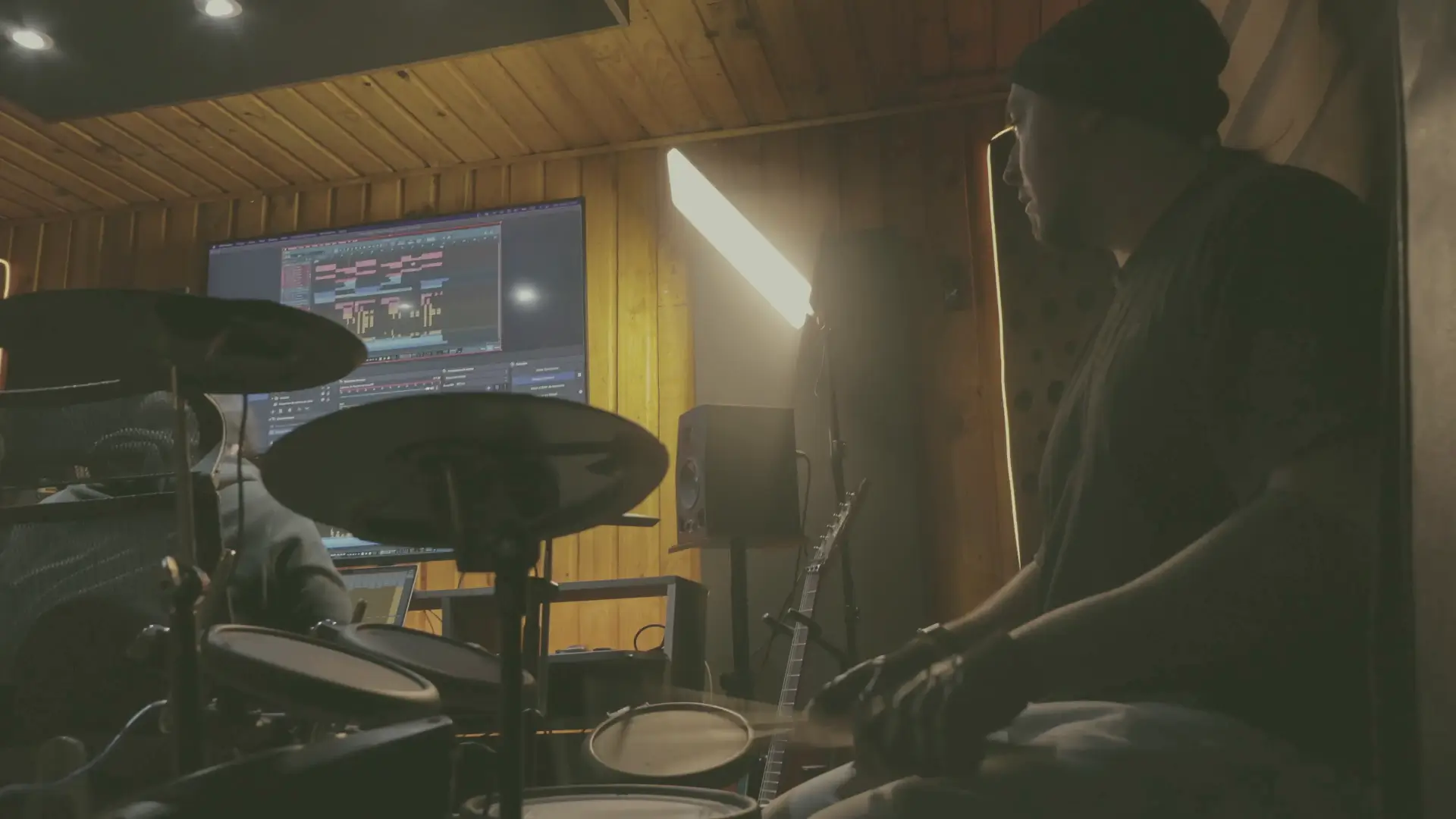
Felipe started the foundation of The Sculptor. We then worked on it at the studio with Pablo, developing the song within the sound Resonance had already been searching for.
It has some traits that might remind you of Traces or Take a Leap, but it is also completely different. By then, we were starting to understand more clearly what we liked, what kind of energy we wanted to keep, and how far we could move within our own sound.
Like the rest of the first album, it became part of that exploration. We did not want to repeat a formula just because something had worked before. We wanted to see what happened when we took the Resonance sound into another theme and another way of telling a story.
A statue sculpting itself
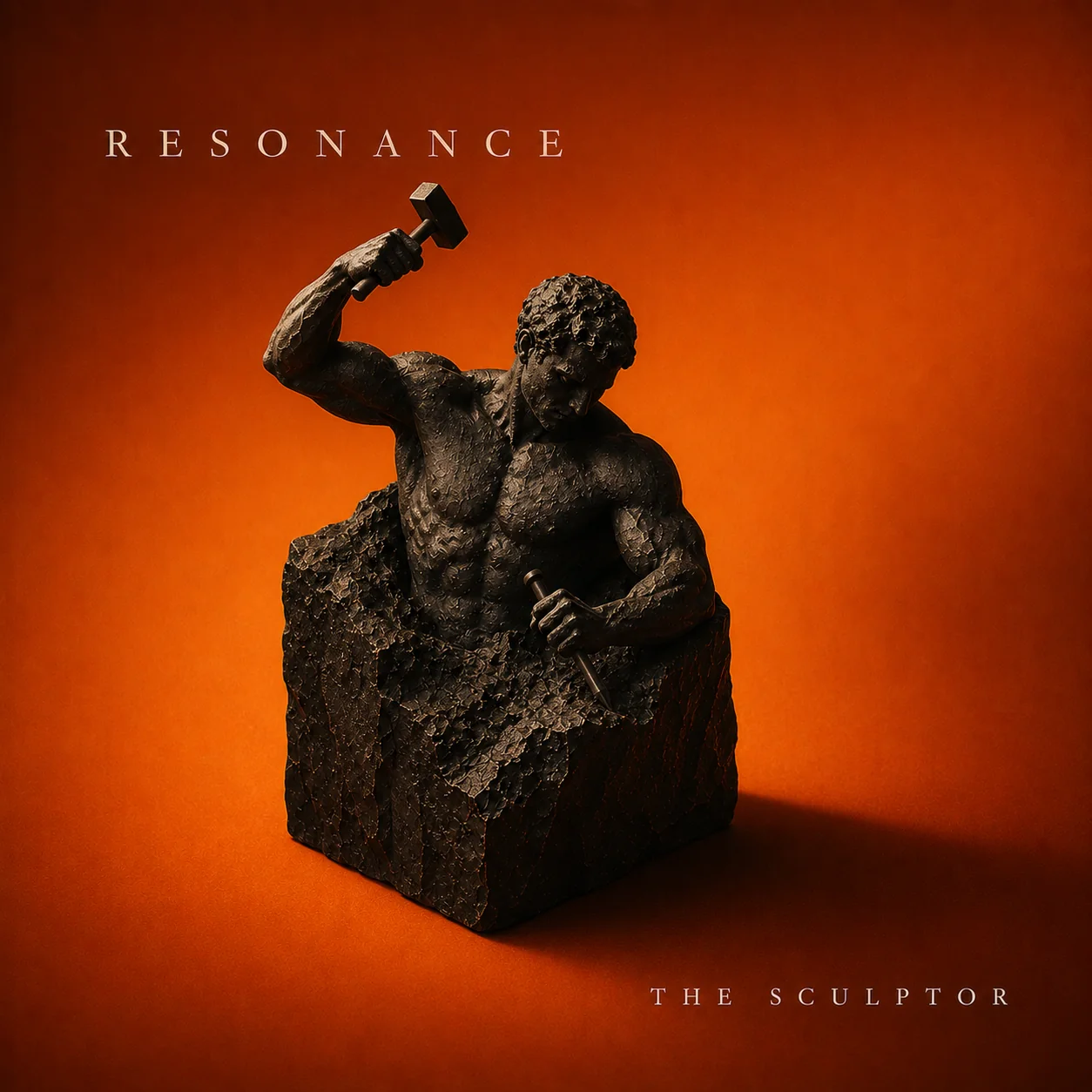
The new cover keeps the concept from the previous version: a Greek-inspired statue torso sculpting itself with a chisel and hammer.
The image says the idea of the song pretty directly. The person is the statue, but also the one holding the tools. They have to hurt themselves in the process of changing, break part of what already exists, and decide what shape they want to have afterward.
Visually, the cover follows the direction we used when renewing the rest of the album: a more minimal, cinematic composition with an orange gradient background.
Listen to The Sculptor
You can listen to The Sculptor while reading the story behind the song.
Listen to *The Sculptor* on Spotify
We need to re-upload the YouTube visualizer and lyric video using the new cover. We also still need to create and upload the instrumental version.
Watch the visualizer on YouTube
The technical story behind the foundation, guitars, production, and recording process can be expanded later in Felipe's companion article for Vendaval Estudios.
KEEP
BUILDING
The technical story behind the song will be covered in Felipe's companion article for Vendaval Estudios.
VENDAVAL COMPANION / COMING SOONLISTEN TO THE SCULPTOR