
For Felipe, a guitar has to catch his eye first. Only then can the conversation move on to comfort, sustain, pickups, tuning, and everything else.
It might sound superficial, but it explains his way of understanding the instrument pretty well. He has tried guitars that were comfortable but gave him absolutely nothing. If a guitar does not spark something when he sees it, it is hard to make him want to pick it up and find out what it can do.
His filter starts with color: teal, cyan, anything with a little something different. Then come the superstrat body, low weight, stainless-steel frets, luminlays, modern hardware, and the way it feels under his fingers.
He is not looking for a guitar that does only one thing well. He wants one that can move across the full Resonance range.
Listen to our songs on Spotify
EVERYTHING STARTS WITH A RIFF
Felipe has played guitar since he was around thirteen. Music came into his life mainly through rock and the bands his father showed him when he was a kid.
Over time, the guitar became much more than a way to play other bands’ songs. A lot of Resonance ideas begin with a riff. From there he starts building the structure and figuring out what it could become.
That is why the guitar is not something that arrives at the end as a recording tool. A lot of the time, the song starts in his hands.
THE IBANEZ THAT DEFINED THE FIRST SOUND
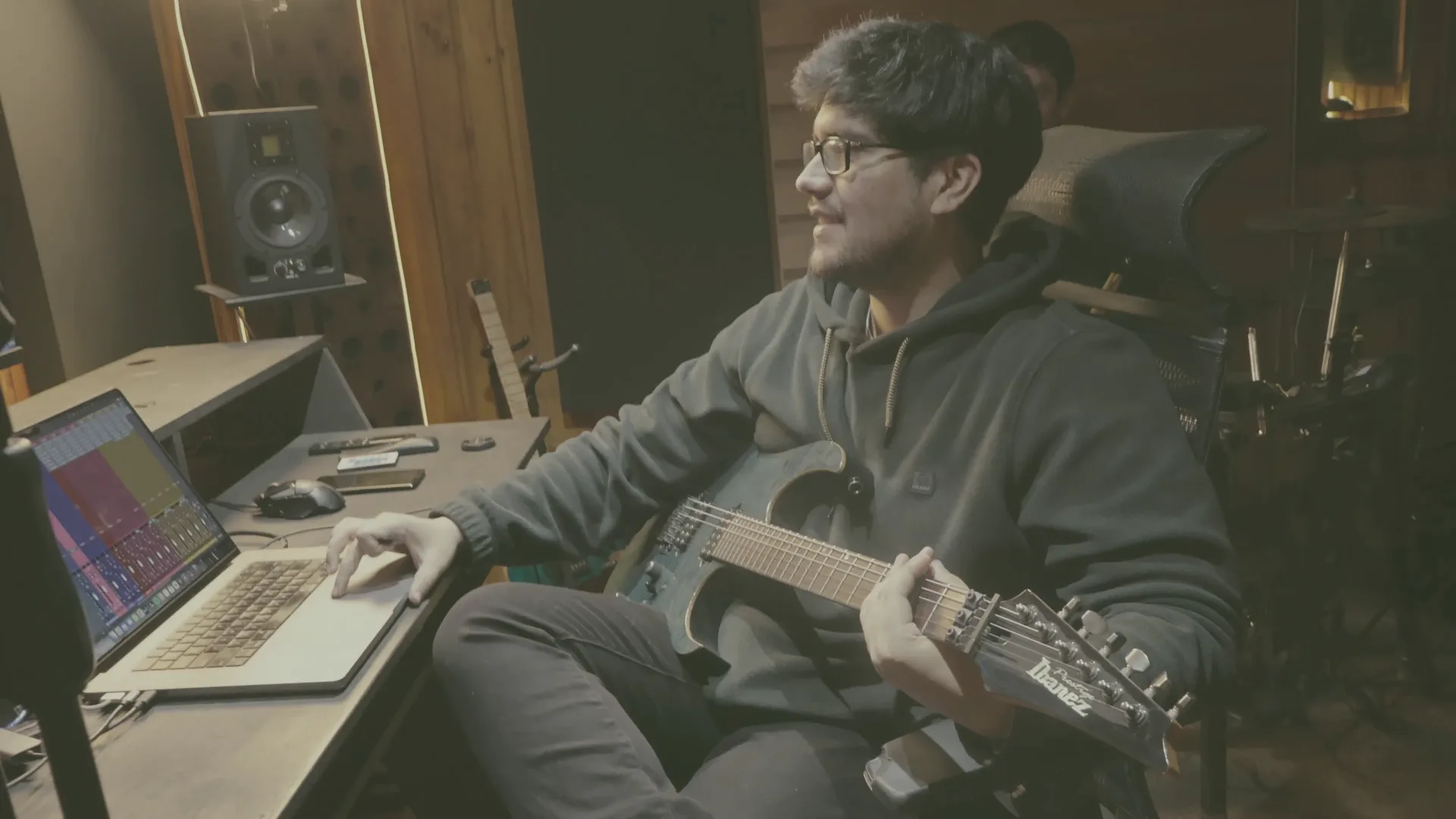
During the first Resonance songs, the Ibanez RG3120TW became a kind of center of gravity.
It is a guitar from around 1998, with a 25.5-inch scale and DiMarzio pickups. Felipe describes it as fairly heavy for an Ibanez, but also as an instrument that has stayed solid for years. The main changes were straplocks and a few screws.
He recorded practically all of his parts on the Resonance songs we have released with that guitar, except Not Enough, where he used an NK Headless because the song was recorded in Drop D.
The Ibanez could move between very different sounds: ambient cleans, filtered leads, split coils, distorted rhythms, and solos. We did not need to change guitars for every idea. It could cover a lot of territory if the pickup, preset, gain, and playing style were handled properly.
FROM THE IBANEZ TO THE SCHECTER AM6
Felipe currently considers the Schecter AM6 his main Resonance guitar. Not simply because it is modern or has premium specs, but because it solves almost every need that comes up in our songs.
It has a lightweight body, Schecter USA Solstice and Equinox pickups, an ebony fingerboard, and stainless-steel frets. For Felipe, that combination makes the instrument feel fast, comfortable, and “snappy” to play.
The basswood body brings resonance and sustain, while the different pickup positions let him move between split-coil sounds, full cleans, more aggressive distortion, and ambient leads. The point is not for all those sounds to be identical. The interesting part is that the guitar can feel like another instrument depending on how it is used.
HOW IT SHOWS UP IN THE SONGS
On Traces, the Ibanez appears in the ambient cleans, verse lead, split-coil riff, rhythms, and chorus leads.
On Take a Leap, it handles the verse cleans, distorted chorus guitars, leads, solo, and the layers that hold the melody together.
On The Sculptor, it appears in the cleans, split-coil leads, chorus rhythms, filtered guitars, and solo. On Still in Time, it covers several chorus rhythms and leads, the split-coil verse, ambient clean, and solo.
On Lending Love, it appears in the chorus lead, the filtered opening sound, and different layers. On Snapped, it returns for Felipe’s recorded parts.
Not Enough is the exception: an NK Headless in Drop D, much lighter—around two kilos—and with a different response from the Ibanez.
- Usual tuning
- Drop C
- Recording exception
- Not Enough in Drop D
- Current strings
- 10–46
- Drop C strings
- 10–52
For Felipe, Drop C feels heavier and tends to push the writing toward more entertaining riffs. Drop D feels a little more open.
THE THINGS MOST PEOPLE PROBABLY DO NOT NOTICE
Some decisions do not necessarily show up clearly in the mix. Felipe uses split-coil sounds often, and he has also used pitch shifting to drop the guitar two semitones without the audience necessarily realizing it is not a real retuning.
In other parts he moves between the bridge humbucker with distortion, the neck pickup for warmer cleans, filtered sounds, and ambient leads. The idea is not to fill a song with tricks. It is to give each section a different texture without losing coherence.
In the mix, he looks for the guitars to find their place in the midrange. Too much low end makes them fight the bass and kick. Too much high end starts to sound harsh. The ideal result has presence while leaving room for the whole band to breathe.
A GUITAR DESIGNED AROUND HIS OBSESSIONS
If Felipe could design the perfect Resonance guitar, it would be teal, with a flame top, luminlays, stainless-steel frets, a roasted maple or wenge neck, ebony fingerboard, basswood or mahogany body, fixed Hipshot bridge and tuners, carbon reinforcement, black hardware, and a satin neck.
It is not a random list. Every element answers a specific obsession: comfort, stability, easy movement, sustain, versatility, and an aesthetic that makes you want to play.
If he had to leave for tour tomorrow with one guitar, he would take the Schecter AM6. It is stable, comfortable, and can cover practically the entire Resonance range: split coils, distortion, full cleans, and leads.
A RESONANCE GUITAR HAS TO SOUND LIKE A THOUSAND THINGS.
Felipe is not looking for a guitar with one fixed personality. He wants an instrument that can transform with the song, the pickup, the tuning, the gain, and the way it is played.