
Every song has a guitar behind it. But a guitar is never only the thing that produces the noise.
Sometimes it is the reason a riff feels immediate. Sometimes it is the answer to a problem we did not know how to name yet. And sometimes it is simply the instrument that stays in the room because one of us refuses to put it down.
When someone hears a Resonance song, they probably think first about the melody, the drums, the voice, or the riff that stays in their head. We can spend a long time talking about something most people may never consciously notice: why that part was recorded with that guitar instead of another one.
Not because we think guitars have magic powers. Pablo is the first to say that, inside a rock mix, almost any guitar can sound good if it is handled properly. But a guitar is also the feeling under your fingers, its stability, its comfort, and the energy you get from picking it up.
Felipe and Pablo approach guitars from pretty different places. Felipe tends to look for modern, versatile instruments that can cover a lot of ground. Pablo pays closer attention to classic guitars, their history, how they feel, and what they mean to him.
The interesting part is that those differences do not compete. They complete each other.
Listen to our songs on Spotify
THERE IS NO SINGLE RESONANCE GUITAR
When we talk about “the guitar used on a song,” we are not always talking about one guitar across the whole track.
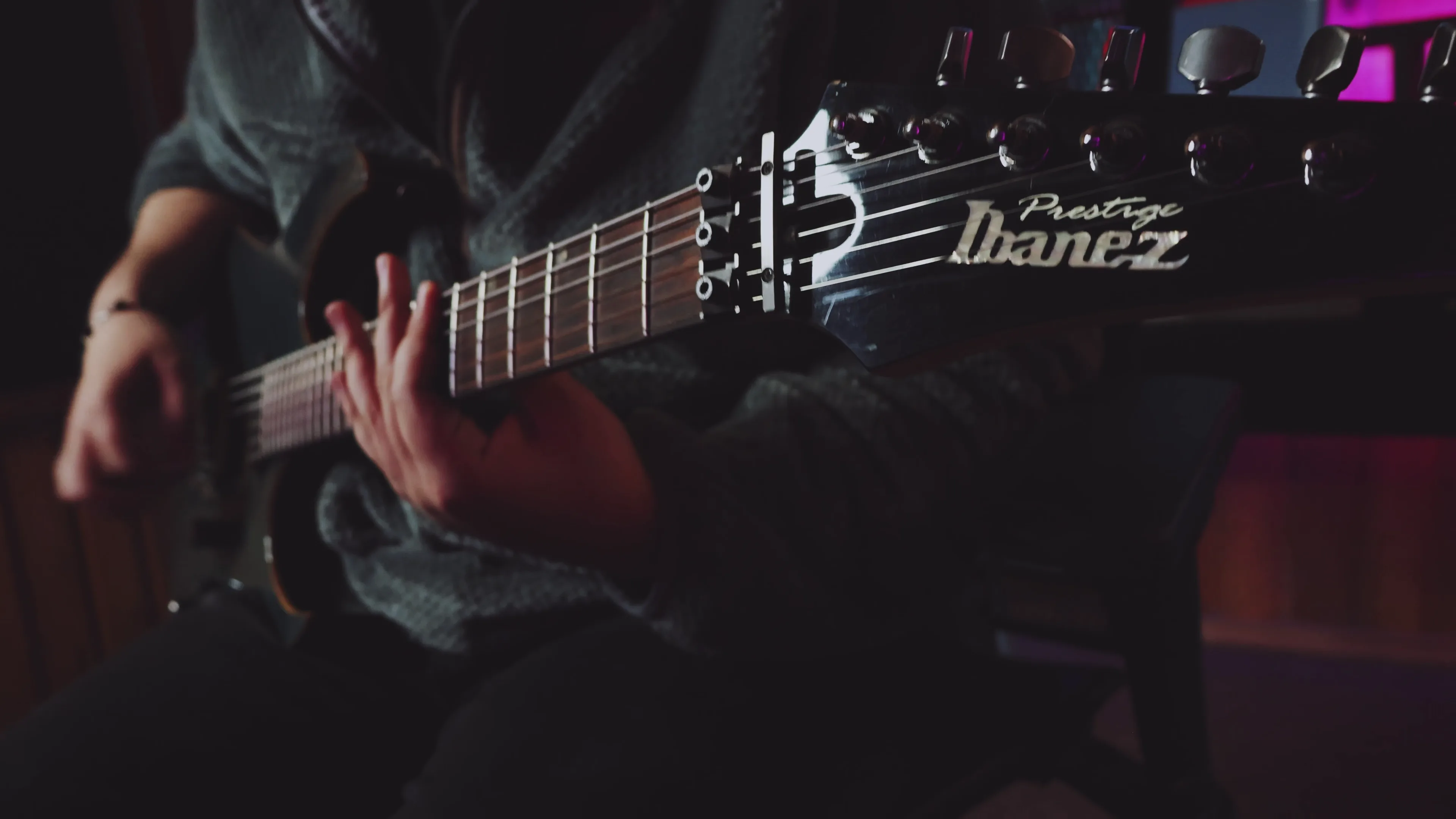
Felipe and Pablo recorded their own parts. One song can have Felipe’s Ibanez on the rhythm guitars, cleans, or leads, while a Gibson, Epiphone, or Washburn from Pablo appears in other layers, solos, or arrangements.
There is no official guitar for each song. There are different decisions that accumulate until they become the final result.
SEVEN SONGS, SEVERAL GUITARS, ONE SOUND IN PROGRESS
Here is the general map we can reconstruct from the guitars each of us used.
TRACES
Felipe recorded his parts with the Ibanez RG3120TW, including the ambient cleans, ambient lead, split-coil riff, rhythm guitars, and chorus leads. Pablo used the Epiphone Les Paul Custom Zakk Wylde, a guitar he had wanted since before he even learned to play and that eventually appeared on the solo.
TAKE A LEAP
Felipe used the Ibanez again for his parts: clean guitars, distorted rhythms, leads, chorus, and solo. Pablo recorded with the Washburn Chicago Tour 24, a 1984 Japanese guitar he found in terrible shape and completely restored.
NOT ENOUGH
This is the main tuning exception on the album. Felipe recorded with an NK Headless in Drop D, while Pablo used a Partscaster Telecaster in Drop D and a Gibson Les Paul in Drop C for different parts. Live, we play Not Enough in Drop C.
LENDING LOVE
Felipe used the Ibanez for his parts, including the chorus lead, filtered sounds, and different guitar layers. Pablo used the Washburn.
THE SCULPTOR
Felipe recorded cleans, split-coil leads, rhythms, chorus leads, filtered parts, and his solo with the Ibanez. Pablo used the Zakk Wylde Epiphone again, including on the solo.
STILL IN TIME
Felipe used the Ibanez for the chorus rhythms and leads, split-coil verse sounds, the ambient clean, and the solo. Pablo used the Washburn.
SNAPPED
Felipe recorded his parts with the Ibanez again. Pablo used his Gibson Les Paul, which he also considers one of the most stable and versatile guitars in his collection.
- Album
- Drop C across every song
- Exception
- Not Enough recorded in Drop D
- Felipe
- 10–46 / 10–52 in Drop C
- Pablo
- 10–52 / 9–46 on the Drop D Tele
Tuning changes the tension, the feeling under your fingers, and the kind of riff that appears naturally. A small detail can define how an entire guitar behaves.
TWO WAYS OF CHOOSING A GUITAR
Felipe starts with his eyes. If he does not like a guitar visually, it is hard for him to get to the testing stage. His filter begins with colors like teal or cyan, superstrat bodies, low weight, stainless-steel frets, luminlays, and modern hardware.
Pablo also needs a guitar to look right, but he tends to look for something more classic: shapes, histories, guitars that seem to have lived a little before they arrived at the studio, and instruments with a personality of their own.
Felipe wants a guitar that can sound like several different guitars. Pablo values an instrument that makes him want to pick it up and play, even before deciding whether it is technically perfect.
THE GUITAR HAS TO SERVE THE SONG.
WHAT YOU HEAR AND WHAT YOU ONLY FEEL
A guitar can be doing important work even when it is not the track you can immediately identify. Our productions have extra layers that fill sections, ambient guitars that hold a transition together, and arrangements that may not stand out on their own.
We also use split-coil sounds, pickup changes, filters, pitch shifting, and different gain levels so a song is not simply “clean guitar versus distorted guitar.” For that to work, there has to be space. The guitars need presence without fighting the bass, kick, or vocal.
IT IS NOT ABOUT OWNING THE PERFECT GUITAR
Felipe imagines a teal guitar with a flame top, stainless-steel frets, luminlays, a roasted maple or wenge neck, an ebony fingerboard, a basswood or mahogany body, Hipshot bridge and tuners, carbon reinforcement, black hardware, and a satin neck.
Pablo imagines something closer to a wine-red Les Paul Custom or a Telecaster, and he would not rule out adding an acoustic guitar for a power ballad someday.
They are different answers to the same question. A Resonance guitar has to sound like a thousand things, but it also has to mean something to the guitarist holding it. That is the part no spec sheet can explain: a guitar has to make you want to play.