
For Pablo, a guitar has to mean something before the conversation about specifications even begins.
Of course he pays attention to action, intonation, frets, bridge, weight, and stability. But a guitar also needs something else: a story, a shape, a reason to want to pick it up.
Since he was a kid, Pablo was drawn to electric guitar through the rock and metal bands he listened to. For him, the guitar has always been a way to have a good time, play songs he loves, create with friends, and find out what appears when you start trying ideas.
Over the years, that relationship became much more specific. Pablo is a nerd about his instruments. He can obsess over their specs, their aesthetics, and even the story a guitar will tell after it joins his collection.
For him, choosing a guitar is not only choosing a sound. It is choosing an object he wants to live with.
Listen to our songs on Spotify
THE GUITAR YOU FIND AFTER TRYING TEN
The Gibson Les Paul Studio came after a very specific search. Pablo bought it new from Walt Grace Vintage, a shop he especially recommends if you like cars and guitars.
Before choosing it, he tried around eight or ten different Gibsons. They did not all feel the same. This was the one that caught his attention most because of how it felt and how it resonated.
He later replaced the pickups with a Seymour Duncan Pegasus and a ’59. At Resonance, it appears on a lead in Not Enough, on some layers in Snapped, and on songs we have not released yet.
The Gibson is also one of the guitars Pablo returns to for reasons that are not only technical. It is stable, versatile, and comfortable, but it also carries a sentimental weight the others do not. If he had to leave for tour with one guitar tomorrow, he would probably take that one.
THE GUITAR HE WANTED AS A KID
The Epiphone Les Paul Custom Zakk Wylde has a different story. Before he even learned to play guitar, Pablo was already a Zakk Wylde fan. As a kid, he would go look at that guitar in a shop where it sat on display.
For years, it was one of those things you look at and think: “someday.” That day came a few years ago, when he finally bought it.
The Epiphone appears on the solo of The Sculptor and also on Traces. Its importance is not only in the notes he recorded with it. It connects the Pablo who did not play guitar yet with the guitarist who now records songs for Resonance.
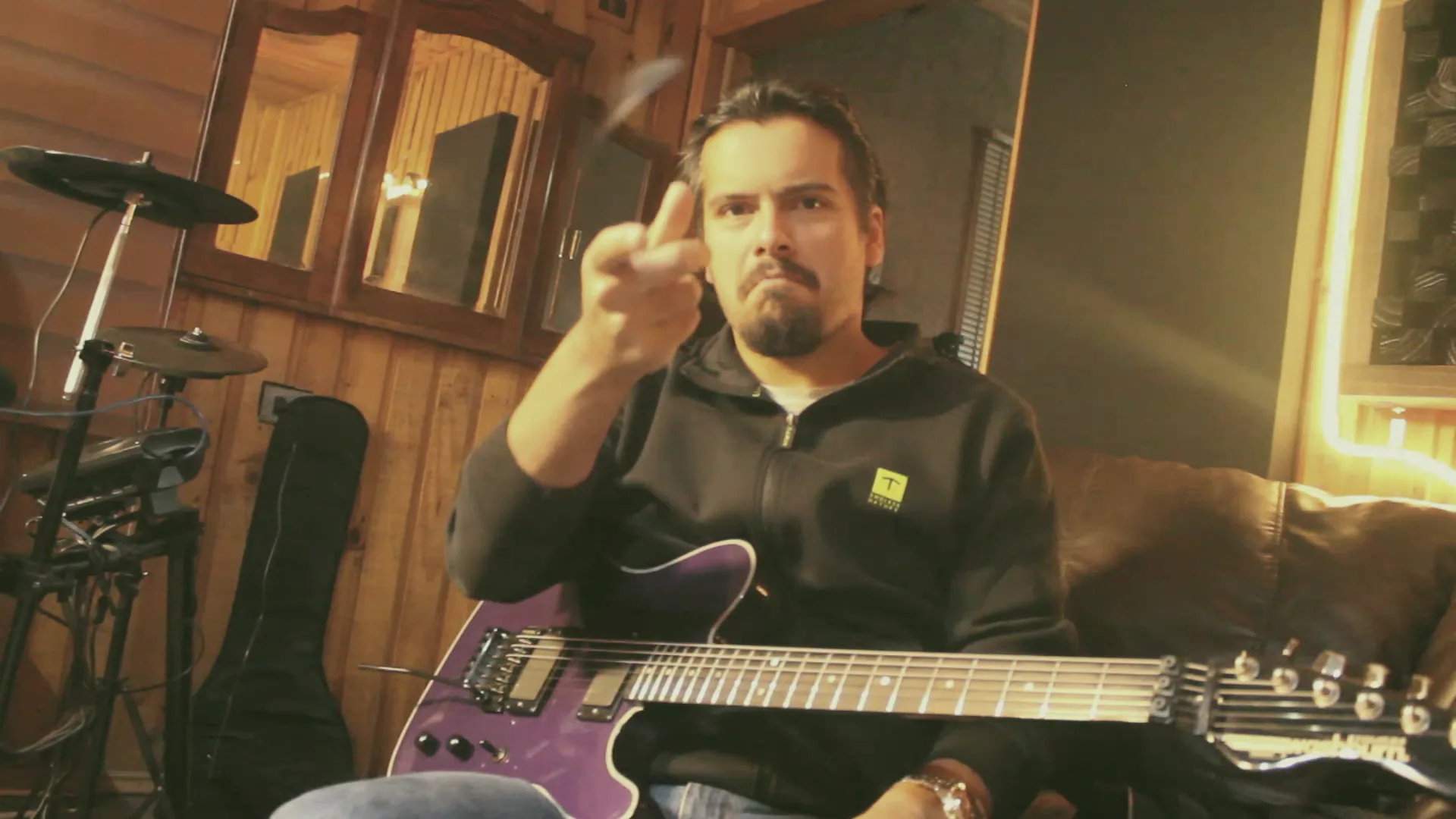
THE WASHBURN THAT CAME BACK FROM THE DEAD
The Japanese Washburn Chicago Tour 24 probably has the most extreme story in the collection.
Pablo found it on Marketplace completely disassembled and in bad shape. It was a rare guitar from around 1984, so he decided it was worth trying to bring back. He had it repainted, replaced the pickups with EMG 81–85s, installed a Gotoh bridge, and had fretwork done.
After all that, it ended up appearing in parts of Still in Time, Lending Love, and Take a Leap.
The Washburn has the kind of personality you probably cannot buy new in a store. It has history, repairs, decisions, and accumulated problems.
It is also Pablo’s most demanding guitar. A floating bridge means tuning it after a setup can become a permanent challenge. There is no grand ritual before recording: tune, plug in, record. But when the Washburn appears, the first part can take a little longer.
A TELECASTER THAT STARTED OUT YELLOW
The Partscaster Telecaster came from another kind of obsession. Pablo found a neck on Marketplace that he liked and started imagining a Telecaster in something close to Burgundy Mist. The body was yellow, so he had it repainted.
The body is Squier alder, and the neck was made in Chile. The guitar appears on Not Enough. It is in Drop D and uses 9–46 strings, different from most of his other Drop C guitars with 10–52.
It is not necessarily the most sophisticated guitar in the collection. But it is one Pablo built around a specific idea. Sometimes he is not trying to find exactly what he wants; he would rather assemble it.
THE CHAPMAN FROM THE HONEYMOON
The Chapman ML3 Classic probably has the most personal story. It was a gift from his wife during their honeymoon.
It has not appeared in a major way on the released songs yet, but it will be part of some album tracks we have not released.
Along with the Gibson, it is one of the guitars Pablo always comes back to. Not because they are the only guitars he could use, but because they carry a meaning that cannot be measured in pickups, scale length, or wood.
- Traces
- Epiphone Zakk Wylde / Drop C
- Take a Leap
- Washburn / Drop C
- Not Enough
- Telecaster Drop D + Gibson Drop C
- Lending Love / Still in Time
- Washburn / Drop C
- The Sculptor
- Epiphone Zakk Wylde / Drop C
- Snapped
- Gibson Les Paul / Drop C
This does not mean each song has one guitar. Felipe recorded his own parts with a different set of instruments, and the final result combines both decisions.
MORE CLASSIC, BUT ALWAYS IN SERVICE OF THE SONG
Pablo recognizes that his tastes are more classic than Felipe’s. He is more drawn to Les Pauls, Telecasters, and instruments with a history you can feel. Felipe looks for modern, versatile guitars. Pablo looks for guitars with personality.
But that difference does not mean either of them defends a choice forever. In the studio, they try to make the decision serve the song and feel right to the band. If a note or riff works better another way, they try another option.
His advice to anyone listening to Resonance is simple: do not worry so much about getting another guitar. Be creative with the one you already have.
WHAT A GUITAR HAS TO DO
If he could design his perfect guitar, it would probably have the shape and character of a Les Paul or Telecaster, perhaps a wine-red Les Paul Custom. He would also like to add an acoustic guitar someday for a power ballad.
But when he finishes the sentence “a Resonance guitar has to…”, his answer is not about a brand or a list of specifications.
IT HAS TO MATTER TO THE GUITARIST PLAYING IT.
That sums up his way of choosing pretty well. A guitar does not have to be perfect for everyone. It has to make the person playing it want to keep playing.